

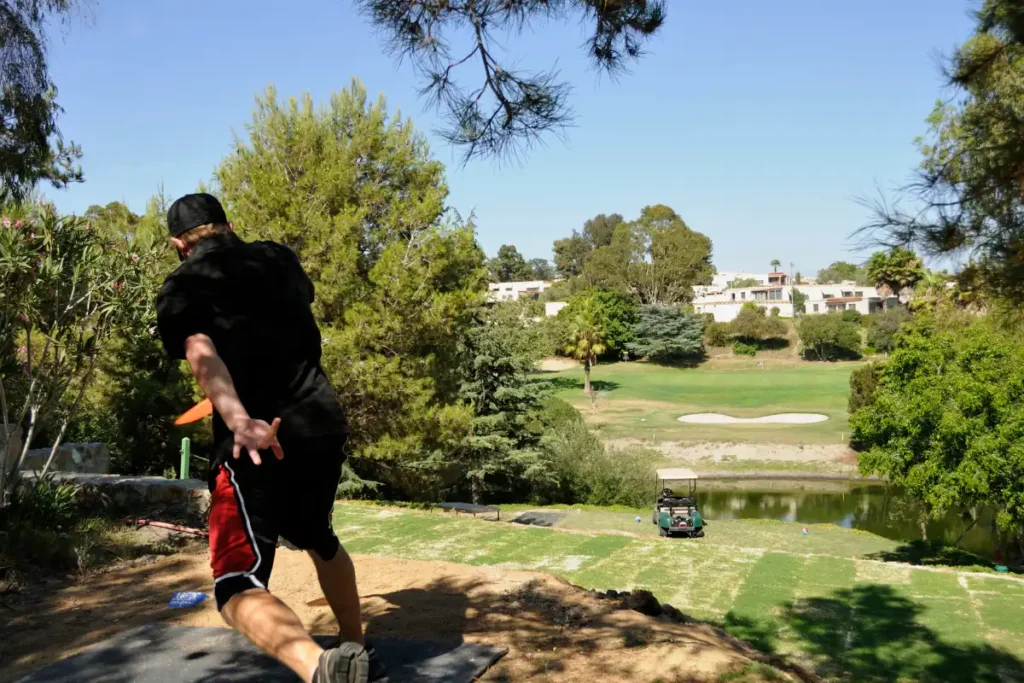
How to Throw a Disc Golf Disc Backhand
The backhand is the workhorse of disc golf—usually the first throw you learn and the one you’ll lean on for distance and accuracy as you level up. This pillar guide breaks down fundamentals, mechanics, discs, drills, and advanced techniques so you can throw farther, cleaner, and more consistently.
What Is a Backhand Throw?
The disc golf backhand pulls the disc across your body with the back of your throwing hand leading, then releases toward the target. For a right-handed backhand (RHBH), the motion starts on your right side and follows through on your left—similar to a tennis backhand. It recruits your legs, hips, core, and shoulders, enabling powerful, spin-rich throws that tend to fly more predictably and farther than many players’ forehands.
- When to use it: Tee shots, straight or left-finishing fairways (RHBH), and any time you want the best blend of distance and accuracy.
- Why it matters: Nearly all distance records are set with backhands, thanks to efficiency and spin generation.
Grip Styles: Power vs. Fan
Power Grip (maximum distance)
All four fingers curl into the inside rim with the thumb on top. The secure “locked-in” feel boosts spin and exit speed—ideal for drives.
- Pros: High snap, high speed.
- Watch-outs: Over-squeezing can cause late releases or wobble (OAT). Requires timing and finger strength.
Fan Grip (control & touch)
Fingers “fan” across the flight plate, with the index along or just inside the rim; the thumb presses on top. Ideal for putters, mids, and touchy fairway shots.
- Pros: Cleaner releases on slower throws; accuracy.
- Trade-off: Slightly less raw power than a full power grip.
Grip pressure: Aim for ~7/10—firm, not tense. Keep the nose of the disc parallel to your forearm to prevent nose-up.
Stance & Footwork (Standstill vs. X-Step)
Stance
Set up sideways to the target, feet slightly wider than shoulders, toes perpendicular to the line. Stay athletic: knees soft, weight balanced on the balls of your feet, chest slightly over toes.
Standstill First
Master a smooth weight shift (back foot → front foot) and a clean upper-body sequence before adding a run-up.
The X-Step (3–4 step run-up)
- Small left step (RHBH) to initiate.
- Cross right step behind the left (the “X”).
- Uncross with left step as you complete reach-back.
- Plant the right foot perpendicular to the line, land on the ball, then pivot onto the heel to brace.
Tempo: Slow → smooth → then fast at the plant. Power comes from rotation and weight shift, not sprinting.
The Throwing Motion
1) Reach-Back
Extend the disc straight back on the intended line, level with your shoulders. At max reach-back, you’re coiled with weight still over the rear foot. By the time your plant foot lands, you should be fully reached back.
2) Pull-Through
- Elbow leads; keep the disc close to the chest into the “power pocket.”
- Pull in a straight line, not a wide arc (prevents rounding and increases efficiency).
- Sequence: Hips → torso → shoulder → arm.
3) Release & Snap
- Neutral/slightly down nose angle to avoid stalls.
- Avoid wrist roll; keep wrist aligned to forearm through the hit.
- Let the disc rip out at max forward extension (don’t “open the hand” early).
4) Follow-Through
Finish the swing naturally on-line and let your back foot come forward to catch balance. This preserves power, improves accuracy, and reduces joint stress.
Disc Selection for Beginners
Start slower and more understable so the disc does the work while you build clean mechanics.
- Speed: Begin ≤ 6 (putters, mids, slow fairways).
- Stability: Neutral to understable (more turn, gentle fade).
- Glide: 5+ helps carry at lower power.
- Weight: Consider lighter (150–165g) to start; mid-160s to low-170s as you progress.
Classic Beginner Picks
- Putter: Dynamic Discs Judge (2/4/0/1) — straight, forgiving.
- Mid: Discraft Buzzz (5/4/-1/1) — neutral, teaches form.
- Fairway: Innova Leopard (6/5/-2/1) — easy glide and control.
Drills & Exercises
- Field Work: Repetition with putters/mids; focus on a single cue each session.
- One-Step Drill: Sync reach-back with the plant to groove timing.
- Towel Snap: Train late acceleration and wrist snap.
- Hershyzer (Wall) Drill: Learn hip-lead and weight shift.
- “Crush the Can”: Teaches bracing on the plant heel.
- Putter-Only Rounds: Force clean mechanics and touch.
- Video/Mirror Work: Identify rounding, nose, timing issues.
- Strength & Mobility: Core, shoulders, grip; keep it injury-smart.
Common Form Mistakes (and How to Fix Them)
- Nose-Up: Keep disc parallel to forearm; shift weight forward; aim for flat/slight nose-down.
- Rounding: Pull straight and tight to chest; elbow leads; don’t open shoulders early.
- All-Arm: Sequence from the ground; drive hips, then torso, then arm.
- Early/Late Release: Smooth acceleration through the hit; adjust grip pressure and tempo.
- OAT/Wobble: Match swing and release planes; firm wrist; practice with putters.
Training Progression: Beginner → Advanced
- 0–3 months: Standstill mechanics; putters/mids 150–200’ clean; angle awareness.
- 3–6 months: Introduce X-step; timing/snap gains; add slow fairways.
- 6–12 months: 300–350’ drivers (varies); line-hitting; early shot-shaping.
- 1–2 years+: Distance/control modes, wind play, hyzer-flips, flex lines, rollers; refinement.
Set milestone goals (e.g., 200’ putter @ 3 months; 300’ driver @ 12 months) but focus on consistency over max distance.
Video Examples (Pros & Trusted Channels)
- Dynamic Discs – “Top 5 Tips for a Better Backhand” (Danny Lindahl)
- Clinic: “5 Tips for More Power on the Backhand” (Eric Oakley)
- “How to Throw a Backhand with Paige Pierce” (with Brodie Smith)
- Overthrow Disc Golf – Backhand breakdowns & fixes
- Scott Stokely – Rounding fixes, “What is Snap?”
- Discmania/Dynamic – “Physics of Flight” series (mechanics & timing)
- Robbie C / Gladiator Disc Golf – Beginner-friendly fundamentals
Tip: Watch in slow-mo, mimic positions, then practice one concept at a time in the field.
Advanced Techniques
Distance vs. Control
- Max Distance: Full coil, smooth-then-fast tempo, hyzer-flip understable/neutral discs, higher apex when calm.
- Precision: Disc down, compact motion, 70–80% power, hit the angle more than the gas.
Wind Play
- Headwind: More overstable, lower/flat, extra nose-down, confident spin.
- Tailwind: More understable or a touch more anhyzer; allow for earlier drop.
- Crosswind: Keep it low/flat; manage which side of the flight plate the wind hits.
Angle Control
- Hyzer: Most consistent; adjust torso tilt; learn hyzer-flip with understable molds.
- Anhyzer: Commit to angle; choose stability based on whether you want long pan or flex-back.
- Flat: Great default when neutral discs and calm conditions align.
Elevation
- Uphill: Add power and lower nose to fight stall.
- Downhill: Reduce power/height, keep nose-down to avoid sail-and-dump.
Safety & Injury Prevention
- Always follow through to dissipate force; don’t “stop” your arm.
- Warm up: dynamic shoulder/hip work + a few towel snaps.
- Build gradually; mix in mobility/strength for shoulders, core, grip.
Mental Game, Self-Assessment, & Adding a Forehand
- Film your throw monthly to spot regressions and measure gains.
- Use field sessions to set process goals (e.g., 20 clean nose-down releases) vs. only distance.
- Develop a serviceable forehand for right-finishing lines and wind versatility; the backhand remains your foundation.
FAQ
Should beginners learn standstill or X-step first?
Standstill. Groove weight shift and clean mechanics first, then add the X-step for momentum and distance.
Why are my throws going nose-up and stalling?
Check wrist orientation (disc parallel to forearm), shift weight forward, and release flat or slightly nose-down.
Do I need high-speed drivers to throw far?
No. Slower, neutral/understable discs will often go farther (and straighter) with developing form. Add speed later.
How do I fix wobble (OAT)?
Match swing plane and release plane, firm the wrist through the hit, and practice with putters until releases are clean.
What’s a simple weekly practice plan?
1× field session (putters/mids), 1× drill block (towel, one-step, Hershyzer), 1× casual round focusing on angle control.
